
'It was almost as though there was widespread relief that the defence bureaucracy, and the minister, could find someone willing to shoulder the blame for everything that had gone wrong with the services under Antony's charge -- the poor preparedness of the forces, slow acquisitions caused by indecision, cancellation of contracts and whimsical blacklisting of defence contractors over the tiniest suspicion that they may have paid speed money or kickbacks.'
To expect that these past decades of grief, inter-group killings, anxiety and fear will be brushed aside because of the Naga peace accord is being unrealistic. Memories are built on old wounds and they heal slowly. So, it is important to be cautiously optimistic, says Sanjoy Hazarika.

Friday's incident at Herat has dampened somewhat the spirit behind the invitation. It reminds Modi much before he officially becomes prime minister, of the challenge that awaits his government, says Sheela Bhatt/Rediff.com

The prime minister, says Ram Kelkar, could do a lot to advance his stature as a national leader by speaking in strong and unequivocal terms on the subject of opposing intolerance and emphasizing the rule of law, thereby setting the tone for the nation and the party.

In Delhi, the poor are pitted against the middle class, with the former led by Arvind Kejriwal and the latter by Prime Minister Narendra Modi.

'Those who have seen the functioning of the Modi government in Gujarat know that the issues related to Hindutva and issues of economy and growth function simultaneously.' 'Modi's politics are based on the understanding of the middle-class consumer society which is in pursuit of material aspirations.' Sheela Bhatt/Rediff.com reveals the Modi government's economic and political plans for the year ahead.

An insecure political class, with little knowledge of the military, has unquestioningly internalised the fear that a powerful tri-service chief would threaten democracy, says Ajai Shukla.
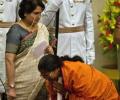
'Yes, it may have been offensive to some, but an expression of regret is all that's called for. No lasting harm has been done, and people should put it behind them, and move on,' says Rajeev Srinivasan, defending Sadhvi Niranjan Jyoti who made abusive remarks in Delhi last week.

Amid souring ties, the president visited Beijing for three days. On his return to India, a hope of better ties has arisen, says senior correspondent R Rajagopalan, who travelled with Pranab Mukherjee to the Asian superpower.

A list of all the foreign visits taken up by PM Narendra Modi this year and their outcomes.
India is also exploring that way but the strength of the Indian economy was such that not even one bank was threatened, not even one insurance company was threatened, and we were able to withstand the shocks.

Jaya Puri Gharti, who served as a cabinet minister during the Maoists' term in government, tells Patrick Ward about the issues facing Nepal and the difficult road to reconciliation.

Addressing a joint session of Parliament on Monday, President Pranab Mukhejee spelled out the Narendra Modi's government's agenda. Here are the highlights of his speech,

'We saw how vigorous democracy was when it dislodged authoritarianism under Indira Gandhi. We saw its vigour again when it voted Mr Modi out of humble origins as prime minister. It was Nehru who laid that foundation for India and what is worrying today is Modi's rather imperial style of functioning,' says writer Nayantara Sahgal.

There are signs of China's external behaviour becoming more aggressive in the coming years. If that happens, strategic implications for neighbours having territorial disputes with China can become deeper and imperatives can rise for the former to counteract, says D S Rajan

'Modi's investment in the relationship with Washington is the biggest deliverable of this visit. He means business and that's fantastic!'

We take a look at Time magazines top world leaders.

How will the return of a majority government at the Centre, the new India-US friendship and the Mangalyaan triumph change India?

'Consider this image of today's youth in Bihar -- armed with a bike, a smartphone and possibly some illegal arms too, imbibing incessant stream of images from the Internet and television.' 'Some of them would turn into gau bhakts, some would listen with interest the exploits of Salafism, dig deep into the Internet to come out with images which cry vociferously that their respective religions are in danger.'
Given her penchant for obfuscating issues Mamata is encouraging the false perception, parroted by her political hangers-on, that all refugees from Bangladesh would face the brunt of deportation once the BJP came to power. In fact, Didi's theatrics and those of all her extras, in the last few days, have been based on propagating this falsehood, says Dr Anirban Ganguly.

'The year in pictures' treks across the globe, looking back on the moments that shaped 2016. From the United States presidential race, to demonetisation in India to the refugee crisis, the news has kept pouring in. Here are our top 50 moments from the world.
Miffed that Narendra Modi's presence has been limited in Varanasi city on Thursday, BJP leader Arun Jaitley slammed the returning officer for denying permission to the party's Bharat Vijay rallies and the Ganga aarti scheduled in the city.

Rajeev Srinivasan on how Indians are satisfied with illusions, not reality.

'... A youth movement which could really transform our politics in a way that the existing elites don't understand.' 'The more you suppress free expression, the more people will value it.' 'The State can't suppress a young society like India where there are so many interesting new ideas emerging,' says Sunil Khilnani, whose latest book Incarnations looks at Indian history through 50 lives.

Under threat from the Maoists, and jailed by the police, AAP's Soni Sori plunges into the election for all she holds dear. Aman Sethi reports

'It is in the interest of both sides that the visit of the US President is seen as being successful. Both sides have invested considerable political capital in it. This rapid exchange of visits and the decisions taken have to be justified, beyond the symbolism, which is no doubt important in itself. This opportunity to impart a fresh momentum to ties should not be missed,' says former foreign secretary Kanwal Sibal.

'J&K continues to have the highest concentration of military personnel anywhere in the world and the alienation of the Kashmiri has increased in the last ten years than ever before.'
 © 2026 Rediff.com - Advertise with us - Disclaimer - Privacy Policy - Sitemap - Feedback - About us - Terms of use - Grievances